
Apollo
Parnassius apollo
winu · Eichstätt
Key facts in one look
- Size
- Wingspan: male 62–86 mm, female 65–95 mm
- Group
- Insect
- Family
- Papilionidae
- Status in Georgia
- Vulnerable
- Activity
- May–September
- Conservation
- LC; VU in Georgia
The Apollo (Parnassius apollo) is a large white butterfly of mountain meadows: its wingspan reaches 95 mm, and its hindwings carry bright red eyespots. Its caterpillar eats stonecrops and similar plants growing in stony places. In Europe its numbers are falling, and in Georgia it is on the Red List as Vulnerable. It was the first butterfly to be protected by law. If you see it on a flowering mountain meadow in summer, do not catch it; just take a photo.
Identification
Apollo: how to identify it
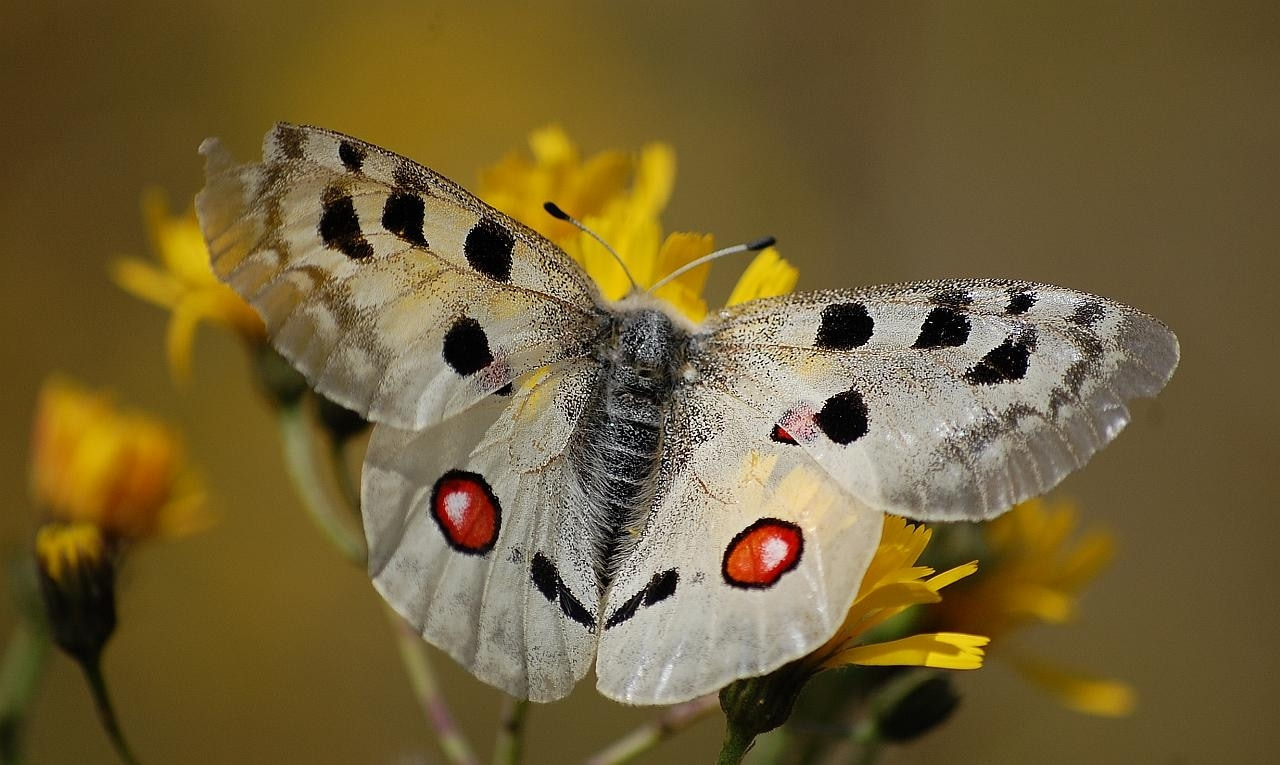
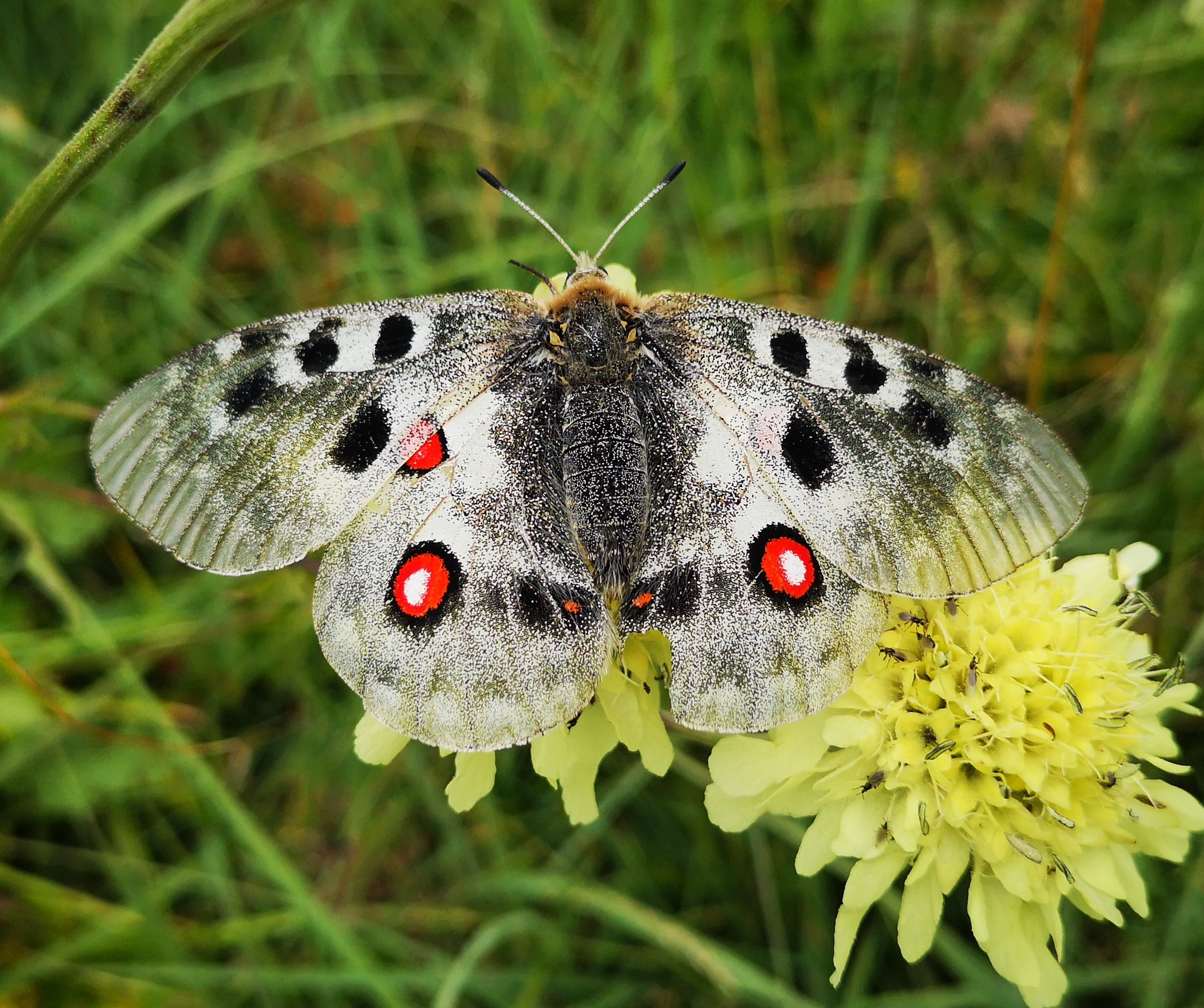
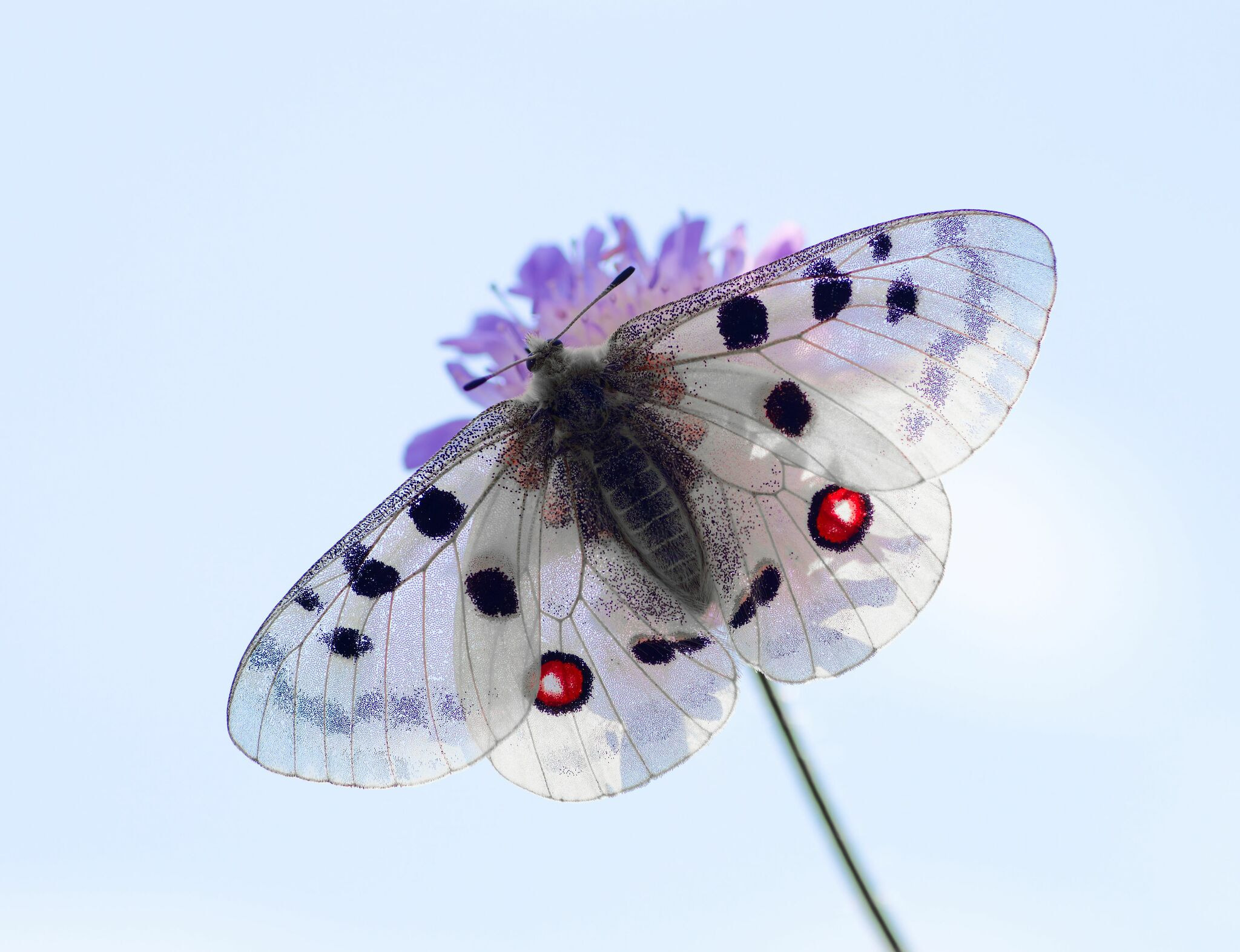
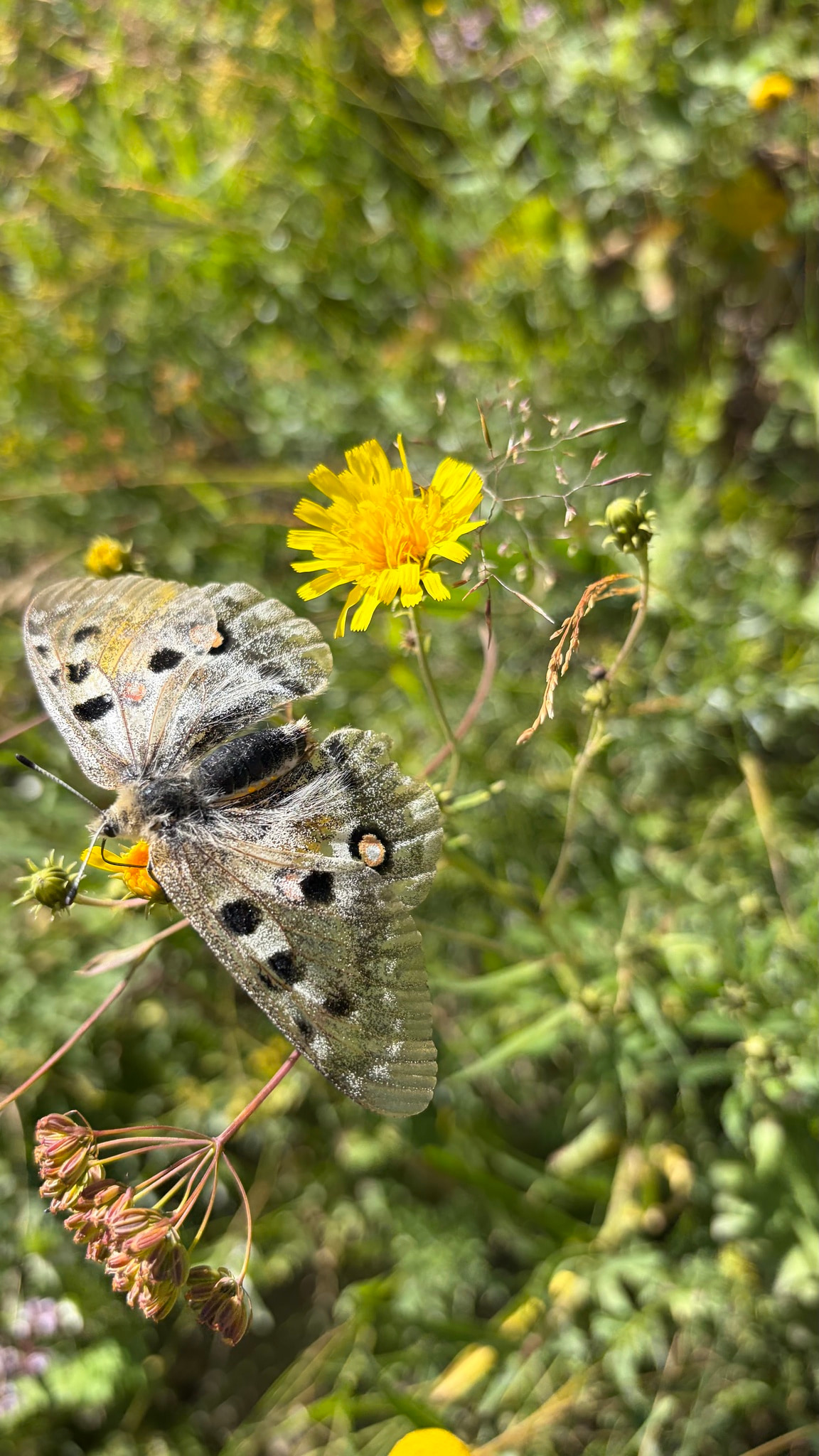
A large white butterfly: the wingspan is 62–86 mm in males and 65–95 mm in females. The first thing you notice is the red, black-ringed spots on the hindwings. The antennae end in a black club.
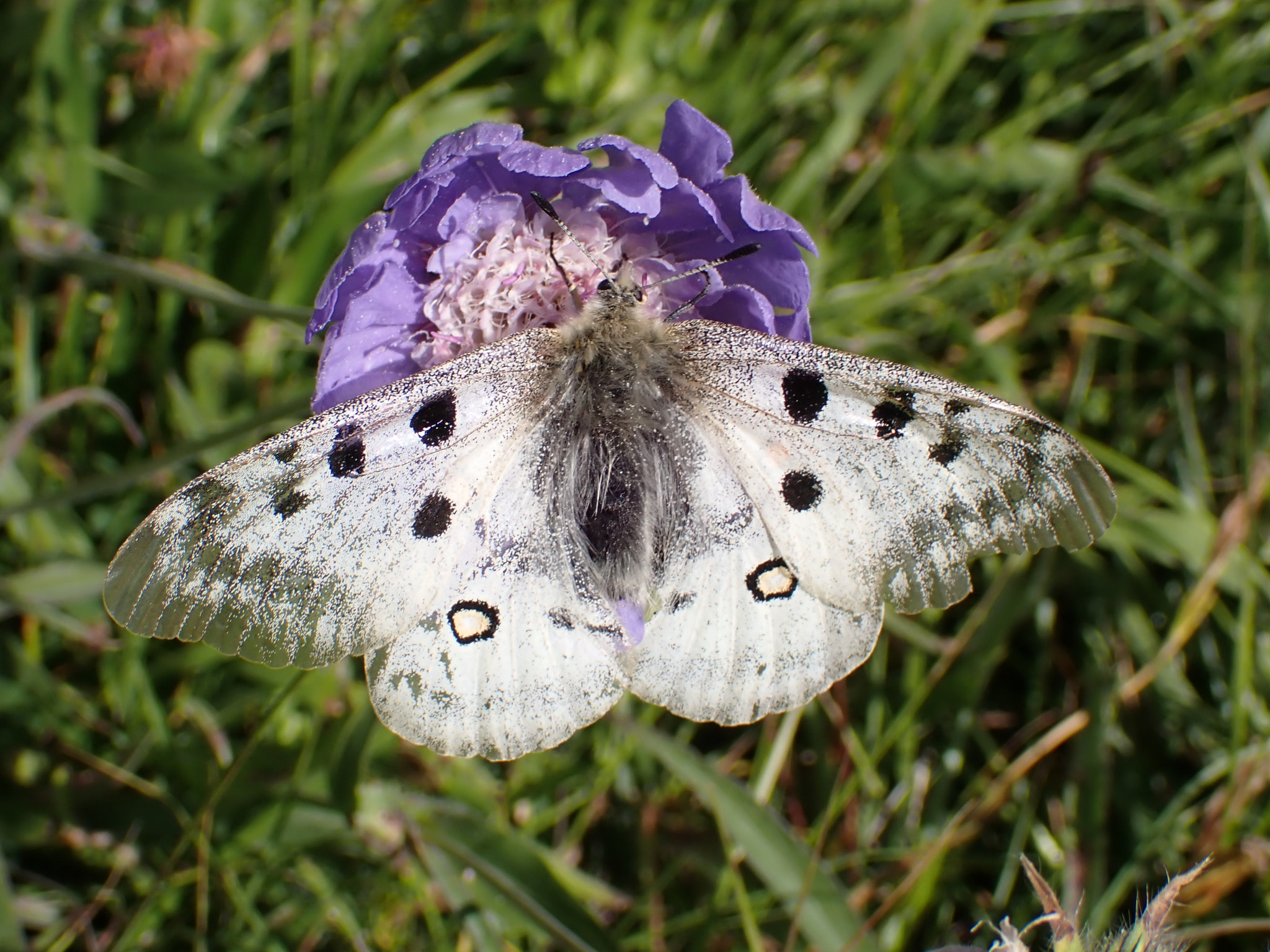
The forewing has five large black spots, the hindwing two red, black-ringed eyespots. In older butterflies the sun fades the red and the spots look orange. So do not rely on the exact shade.
The similar small Apollo (Parnassius phoebus) lives in high mountains. It has strongly black-and-white antennae and two red spots near the tip of the forewing. The Apollo's antennae end in a black club.
The caterpillar is velvety black with two rows of red or orange spots along its sides and grows up to 50 mm. In colour it resembles the millipede Glomeris guttata. When threatened it pushes out a yellowish-red organ behind its head that gives off an unpleasant smell.
Colour
The wings are white, sometimes cream, slightly transparent near the edges. A broad grey band runs along the outer edge of the wing. The forewings carry five large black spots, the hindwings two bright red, sometimes orange, eyespots. The size and shape of the spots vary greatly. A freshly emerged butterfly has yellowish wings at first.
Swatches are illustrative. Do not identify a species by colour alone.
The Apollo is a mountain butterfly. It lives on hills and flowery alpine meadows, mountain pastures and stony slopes where its caterpillar's food plants grow. It occurs from 400 m up to 2,300 m, but mostly above 1,000 m. It needs cold winters, sunny summers and wide open spaces with little shrub cover and plenty of grass. It also lives in the Caucasus and Transcaucasia.
The Apollo is listed as Vulnerable (VU) on Georgia's Red List. Most records come from Mtskheta-Mtianeti and Samegrelo-Zemo Svaneti, followed by Samtskhe-Javakheti, Kakheti and Racha. It has also been found in Tbilisi, Kvemo Kartli, Adjara, Shida Kartli and Imereti. Adults have been recorded from late May to September, most of them in July and August. The oldest records are museum specimens collected in 1913 and 1914, some of them at Abastumani.
Data: Reptiles.ge + iNaturalist · Methodology
- Field observation
- Several records in one spot
- Photo record
- Region with records
The caterpillar eats stonecrops (Sedum), including Sedum telephium and Sedum album, as well as the Caucasian Hylotelephium caucasicum and houseleeks (Sempervivum). It sometimes bites off the top of a food-plant stem up to 20 cm long and eats it on the ground. The adult butterfly drinks nectar. It mainly visits large flowers: thistles (Cirsium), knapweeds (Centaurea), oregano (Origanum vulgare) and clovers (Trifolium).
There is one generation a year. Adults fly from May to September. They fly slowly, often gliding and settling on flowers, and are most active around midday. A disturbed butterfly sometimes drops onto its back, opens its wings to show the red spots and makes a hissing sound with its legs. After mating, the male leaves a sphragis on the female's abdomen, a hard plug that prevents her from mating again. The female lays 90–120 eggs, one at a time, on or near the food plant. The egg overwinters and the caterpillar hatches in spring. The caterpillar moves only in sunny weather and hides in dry grass and under stones on cloudy days. It pupates on the ground in a loose cocoon.
On the global IUCN Red List it is not threatened (LC, 2021). On the European Red List it is Near Threatened (NT, 2010): its European population fell by almost 30% in ten years, and over the last 100 years it has disappeared from several mountain ranges. The main threat is habitat change: conifer plantations, meadows overgrown by scrub, farming and urbanisation. It is listed in Appendix II of CITES and Annex IV of the EU Habitats Directive. On Georgia's Red List it is Vulnerable (VU).
Related guides
Continue with related pages
Yes, it is part of Georgia's fauna and is on the country's Red List as Vulnerable (VU). It is a mountain butterfly that chooses flowery meadows and stony slopes. The Caucasus is part of its range. Its exact distribution in the country has not yet been described in detail.
They are two different species. The Caucasian Apollo (Parnassius nordmanni) is Endangered (EN) on Georgia's Red List, the Apollo Vulnerable (VU). Both are white mountain butterflies. So a good photo of both sides of the wings helps to identify the species.
Mainly because of habitat loss. Meadows are overgrown by scrub, and in places they are planted with conifers or used for farming and building. In some places collectors have also done harm, and elsewhere motor vehicles. In Europe its population fell by almost 30% in ten years.
The eyespots serve to startle a predator or to draw its attention away. The butterfly also tastes bad: it takes a bitter substance from its food plant and stores most of it in the wings. Some birds therefore tear off the wings first and then eat the body. In older butterflies the sun fades the red to orange.
References
What this profile is based on
Species profiles are compiled from peer-reviewed literature and established biodiversity databases, and are reviewed as new taxonomic and conservation data become available.
Prepared by the Reptiles.ge editorial team from the sources listed here.