
Turtles
World's largest sea turtle confirmed for the first time in Turkey's Black Sea
A new paper describes the first confirmed records of the leatherback turtle on Turkey's Black Sea coast. One animal was found dead in Sakarya in 2025, and another was seen alive off Rize in April 2026.
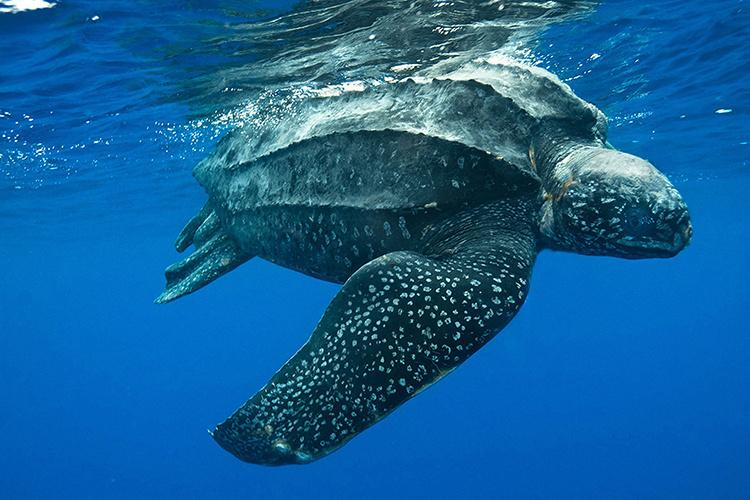
The world's largest living sea turtle has now been officially confirmed from Turkey's Black Sea coast. A 2026 paper in the Journal of the Black Sea / Mediterranean Environment reports two records of the leatherback turtle (Dermochelys coriacea).
What the study confirmed
According to the authors, these are the first confirmed records of Dermochelys coriacea from Turkey's Black Sea coast.
The second record is especially relevant regionally: a live leatherback was observed on 7 April 2026 off Rize Province, in the eastern Black Sea. That makes the record interesting for the wider context of Georgia's Black Sea coast, although it is not a Georgian record.
Two Black Sea records
The first case was recorded on 13 April 2025, when a female leatherback turtle was found dead on Karasu Beach in Sakarya Province on Turkey's western Black Sea coast. Researchers performed a necropsy, including external and internal examination, morphometrics, and biological sampling.
The second case followed almost a year later. On 7 April 2026, a live leatherback turtle was observed near the coast of Rize Province. The authors treat the two cases together as the first confirmed leatherback records for Turkey's Black Sea coast and note that they are the northernmost confirmed records of the species in Turkish seas.
Why the record is unusual
Leatherbacks are the largest living sea turtles. Unlike hard-shelled sea turtles, they have a dense, rubbery skin over the body surface, which gives the species its English name. They move over very long distances and feed largely on soft-bodied marine animals, including jellyfish.
The Black Sea is not part of the species' usual regular range. Historically, sea turtle records in the region are rare, with occasional records better known for loggerhead turtles (Caretta caretta) and green turtles (Chelonia mydas).
What it means for Georgia
This paper does not confirm Dermochelys coriacea from Georgia. It documents two cases from Turkey's Black Sea coast. The Rize observation matters for Georgia because it comes from the eastern Black Sea, but a confirmed record from Georgia's coast would still be needed before adding the species to Georgia's fauna.
The authors also discuss plastic pollution in the Black Sea as a growing threat. They do not identify plastic as the cause of death for the dead individual, but floating plastic can be important for leatherbacks because some debris can resemble soft-bodied prey.
Sources
First records of leatherback turtle Dermochelys coriacea in the Black Sea, Turkiye. Journal of the Black Sea / Mediterranean Environment, 2026.
2024 Istanbul Strait record and NOAA Fisheries species profile.
