


“Lukhuma” killed: GPS-tagged bearded vulture shot after its return to the wild
A bearded vulture released in the Pankisi Gorge after four months of treatment was found with gunshot wounds in Akhmeta. It died soon after it was taken to Tbilisi Zoo.

According to Veterinarium, the clinic of the Agricultural University of Georgia, Lukhuma, a bearded vulture found in the Pankisi Gorge in June, was treated for four months and released with a GPS transmitter in October. Two days after the transmitter’s first signal, the bird was found wounded in Akhmeta. Gunshot wounds killed it. The clinic estimates that only 20–25 pairs of bearded vultures live in Georgia.
What happened to Lukhuma?
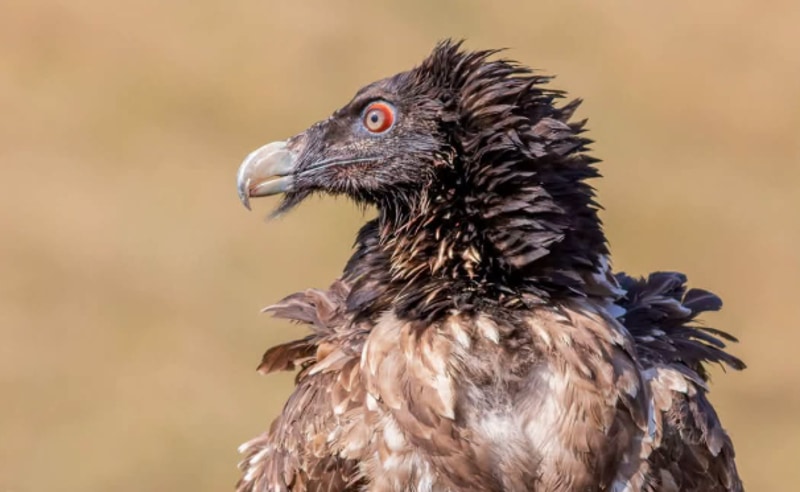
A bearded vulture (Gypaetus barbatus) chick was found in the Pankisi Gorge at the end of June. The weakened bird could no longer fly, so it was brought to Tbilisi. The people who found it named it Lukhuma. It went through treatment and a long rehabilitation at Veterinarium, the clinic of the Agricultural University of Georgia. According to the clinic, up to 15 people worked to save Lukhuma over four months.
The clinic shared the news, and on 3 November Metronome and Sputnik Georgia published it. By 4 November we could not find the clinic’s original post, so this article relies on those two publications. Both repeat the same statement from the clinic.
How was it released, and what happened next?
Once recovered, Lukhuma was returned to its natural habitat at Tbatana in the Pankisi Gorge in October. The sources do not give the exact day. Before the release, Luka Tkemaladze and Lekso Gavashelishvili fitted the bird with a GPS transmitter to follow its movements.
According to the clinic’s statement, the transmitter’s first signal came three days before the statement. The day before the statement, Lukhuma was found wounded and weak in Akhmeta, Kakheti. The Department of Environmental Supervision took it to Tbilisi Zoo. Deep gunshot wounds had caused bleeding, and the bird died soon after it arrived.
Why is one bird such a loss?
The clinic estimates that only 20–25 pairs of bearded vultures live in Georgia. In the clinic’s words, for such a small population “the loss of every single bird is a heavy blow”. The Georgian government’s 2014 Red List classifies the bearded vulture as vulnerable (VU), while the 2024 checklist of birds rates it as NT for Georgia. Why the Red List has not been updated is covered in our 28 October article on the State Audit report.

The bearded vulture is a large bird: its wingspan reaches 2.3–2.9 metres. It feeds on the remains of dead animals, mostly bones. It lives in rocky mountain gorges, stays in Georgia all year and breeds here. The clinic explains that the bearded vulture poses no threat to livestock, poultry or other farm animals. Lukhuma did not approach people either.
What is not known?
The sources do not say who shot Lukhuma or whether an investigation has been opened. We cannot answer these questions until official information appears. Nor do they say where exactly in Akhmeta the wounded bird was found. Sputnik’s first paragraph names the Pankisi Gorge, while the clinic’s quote names Akhmeta.
Hunting violations made the news from Batumi this autumn too: according to AFP, 39 hunting violations were recorded in the region in the first month of the season. More about the bearded vulture’s life, food and range is on its profile, and other birds are on the birds hub.

