


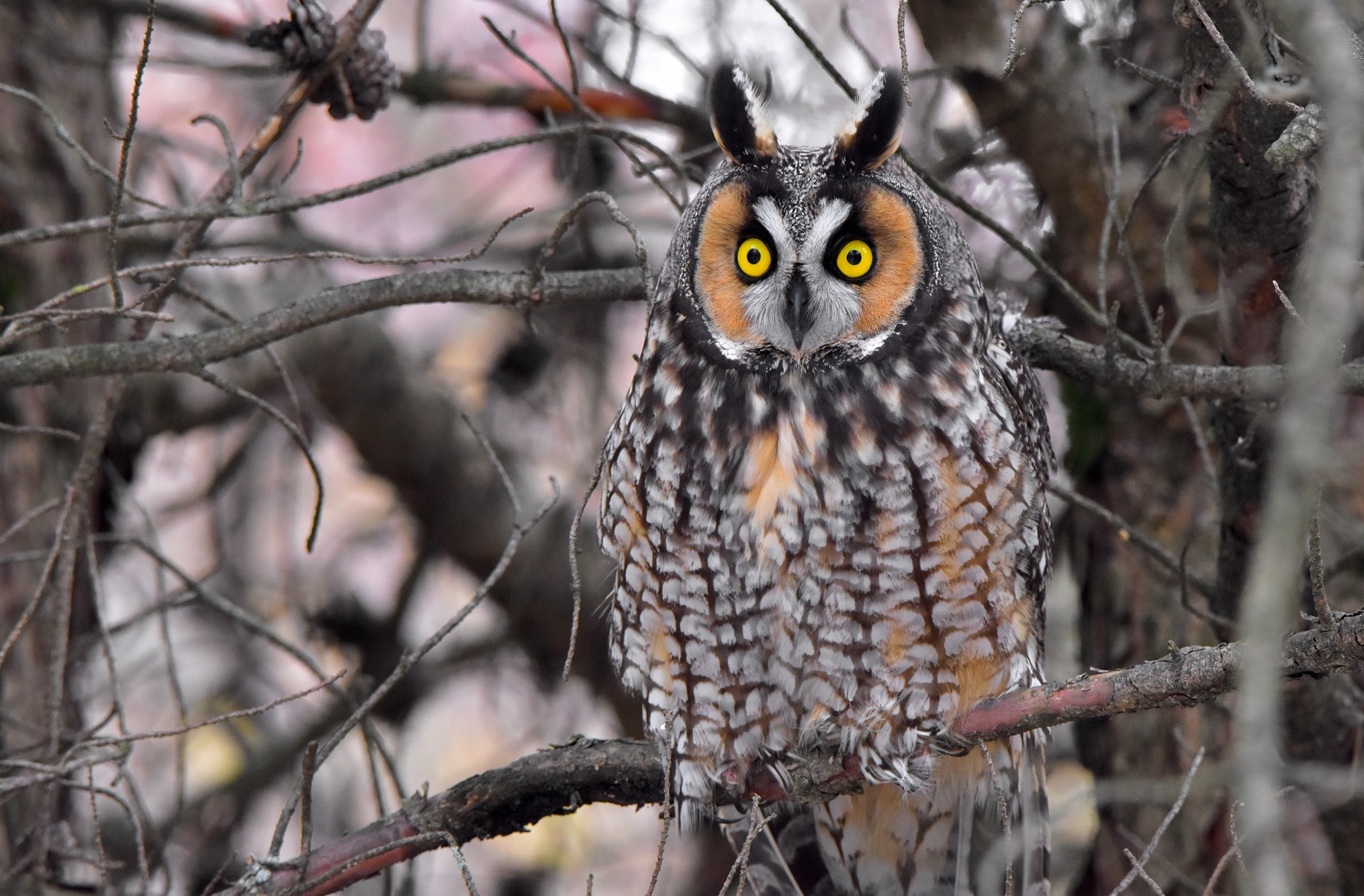

Northern long-eared owl
Asio otus
Dean Hester · Iowa
Key facts in one look
- Size
- 31–40 cm
- Diet
- Small rodents; sometimes birds and insects
- Status in Georgia
- Year-round resident, breeds
- Habitat
- Woodland edge, groves, conifer parks
- Family
- Strigidae
- Protection
- Globally LC, 2018; in Georgia LC, 2021
The long-eared owl has two long, upright tufts of feathers on its head that look like ears. Its real ears have nothing to do with them: they sit on the sides of its head, and it hears so well that it finds a rodent in the dark by its rustling. It spends the day on a branch, pressed against the trunk in dense foliage, and hunts at night. In Georgia it lives and breeds all year round, In winter it often roosts in groups, sometimes in city parks too.
Identification
Northern long-eared owl: how to identify it
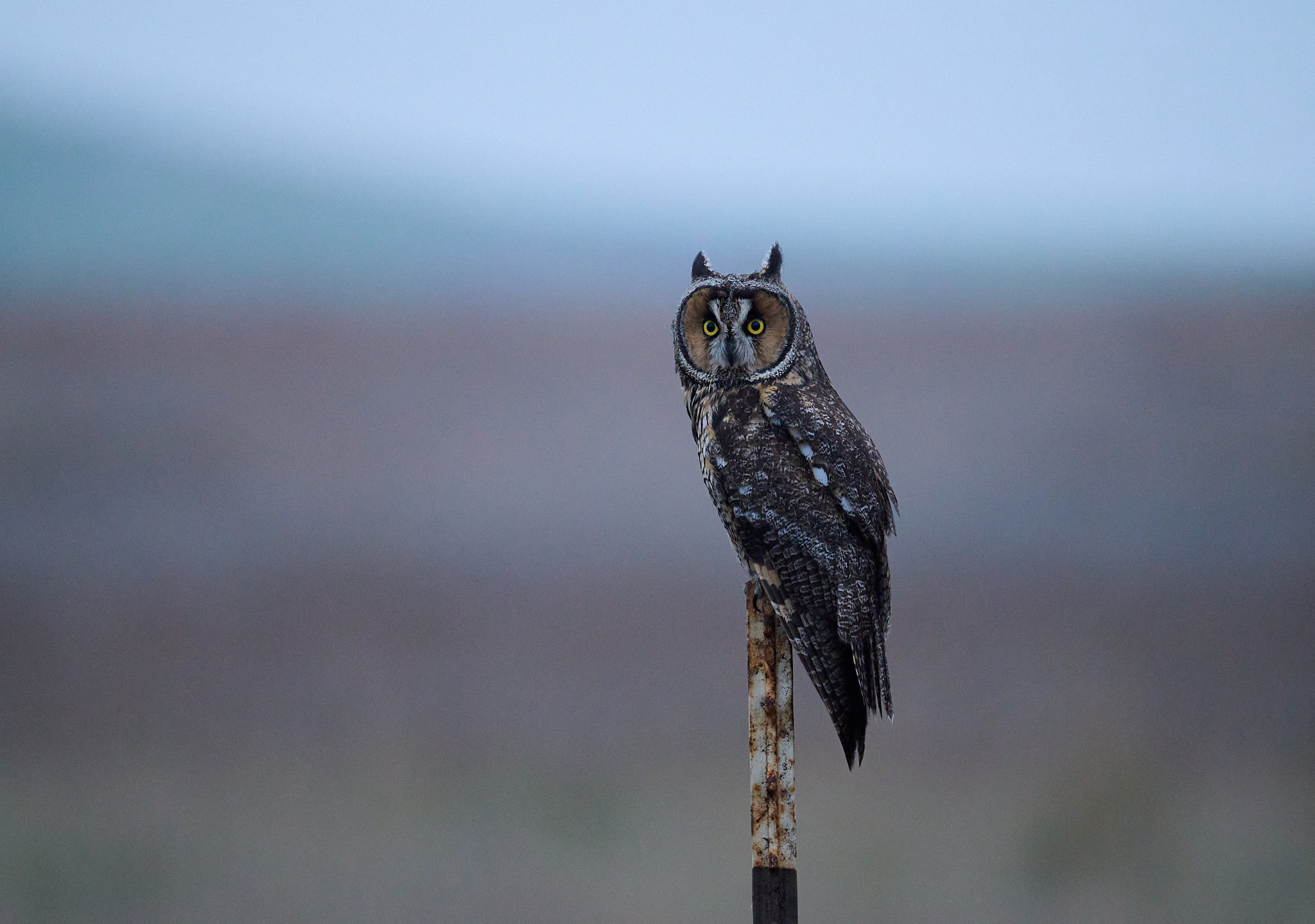
A slim owl 31–40 cm long, with a wingspan of 86–102 cm. It has long, upright feather "ears" on its head, and its eyes range from yellowish-orange to orange-red.
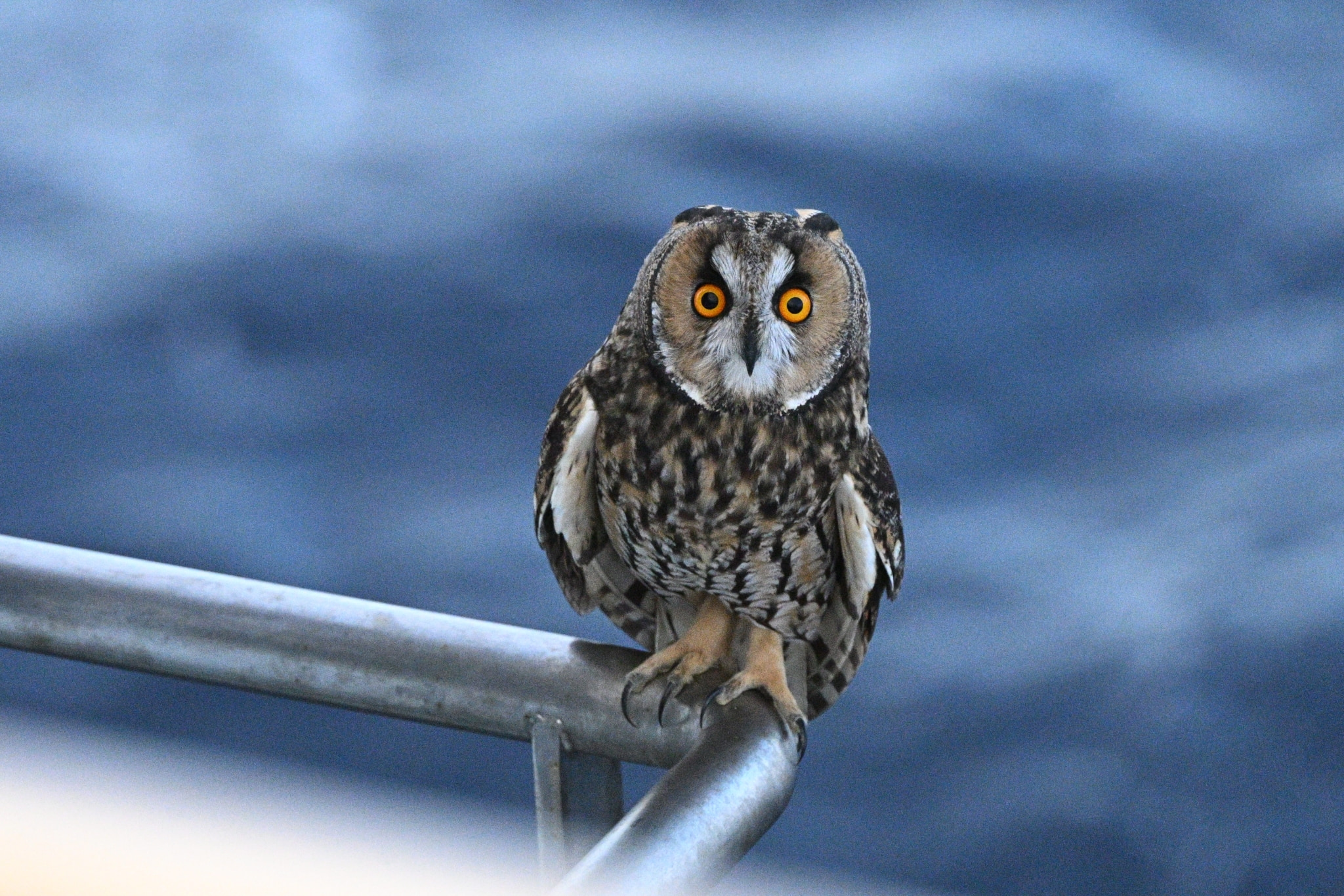
Length 31–40 cm, wingspan 86–102 cm. The body is slim and light: it often weighs half as much as a tawny owl. Males weigh 160–330 g, females 180–435 g. The female is the larger.
The plumage is ochre-tawny with a grey or brown wash, with dark streaks above. The underparts are streaked all the way down, with a herringbone pattern on the belly. The facial disc is well defined, rimmed dark, with white lines by the bill. The bill is blackish, the legs and toes feathered. The "ears" sit close to the middle of the head.
The short-eared owl has short, almost invisible "ears", yellow eyes and paler, sandier plumage, and its streaking ends on the breast. The tawny owl has no "ears", dark eyes and a round head. The eagle-owl has "ears" too, but it is much bigger and its "ears" sit at the edges of the head. If you see a slim, upright owl with long "ears" in a tree in lowland woods, it is most likely a long-eared owl.
Colour
Swatches are illustrative. Do not identify a species by colour alone.
Often confused with

It picks semi-open country, above all woodland edge: it roosts and nests in dense stands of trees and hunts over open ground, fields, hedgerows and rough grassland. It often settles in towns and villages, in conifer parks and in groves on their edges. Among forests it prefers conifers, where its colours make it harder to see. In Georgia it lives and breeds all year round. It has been photographed near Akhalkalaki in July and near the village of Akhali Samgori in May.
The long-eared owl lives and breeds in Georgia all year round. Most records come from Kakheti, above all around Dedoplistskaro, and from Samtskhe-Javakheti, around Akhalkalaki. It has also been found in Imereti and Adjara. Records run from April to August and in October and November, with the most in May. The oldest records come from Imereti, in July 2014.
Data: Reptiles.ge + iNaturalist · Methodology
- Field observation
- Several records in one spot
- Region with records
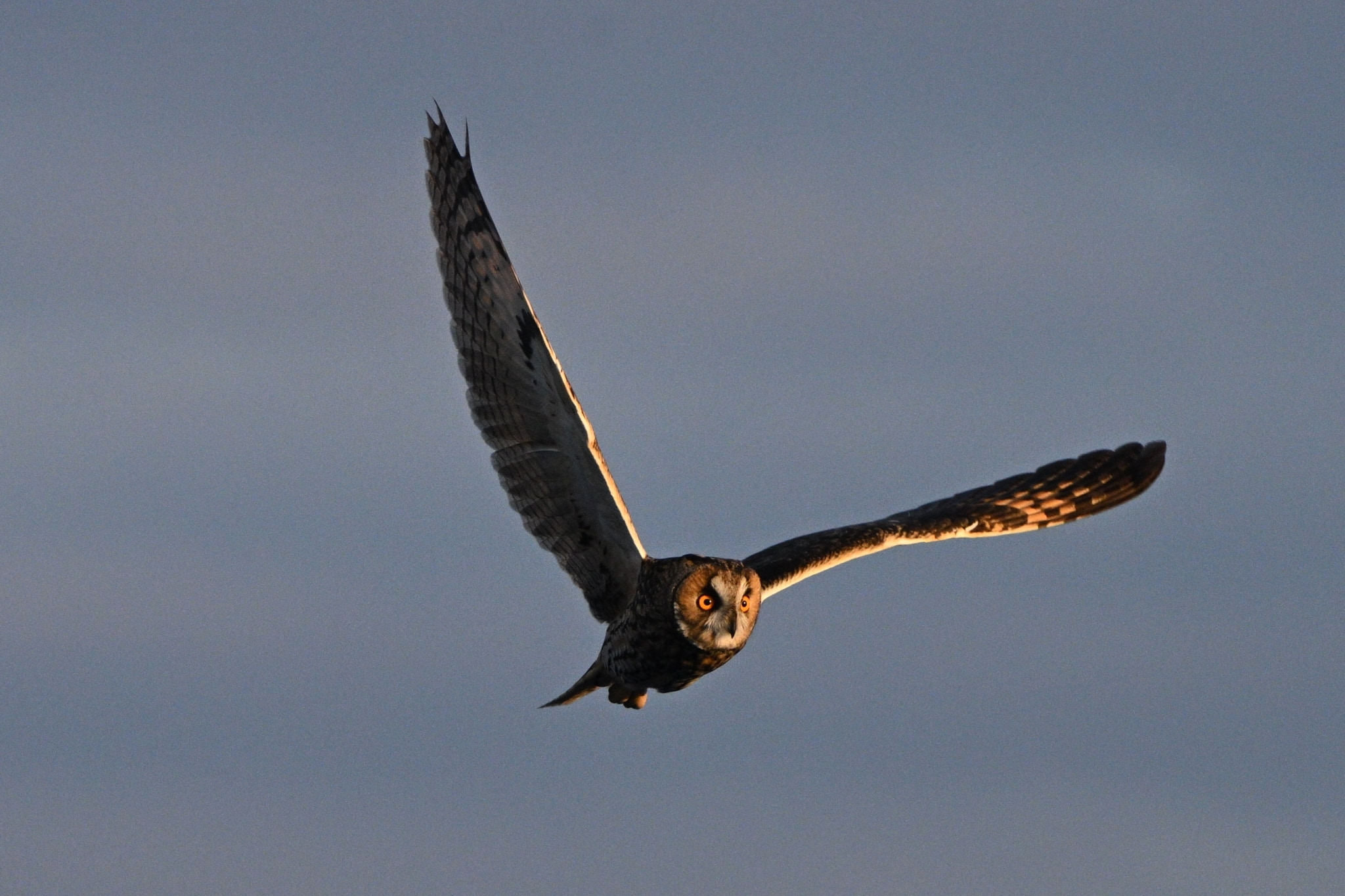
It feeds above all on small rodents, especially voles and mice. In the breeding season, and where rodents are scarce, it also takes birds and insects. It hunts on the wing, slowly, about 1.5 m above the ground. It finds its prey more often by sound than by sight.
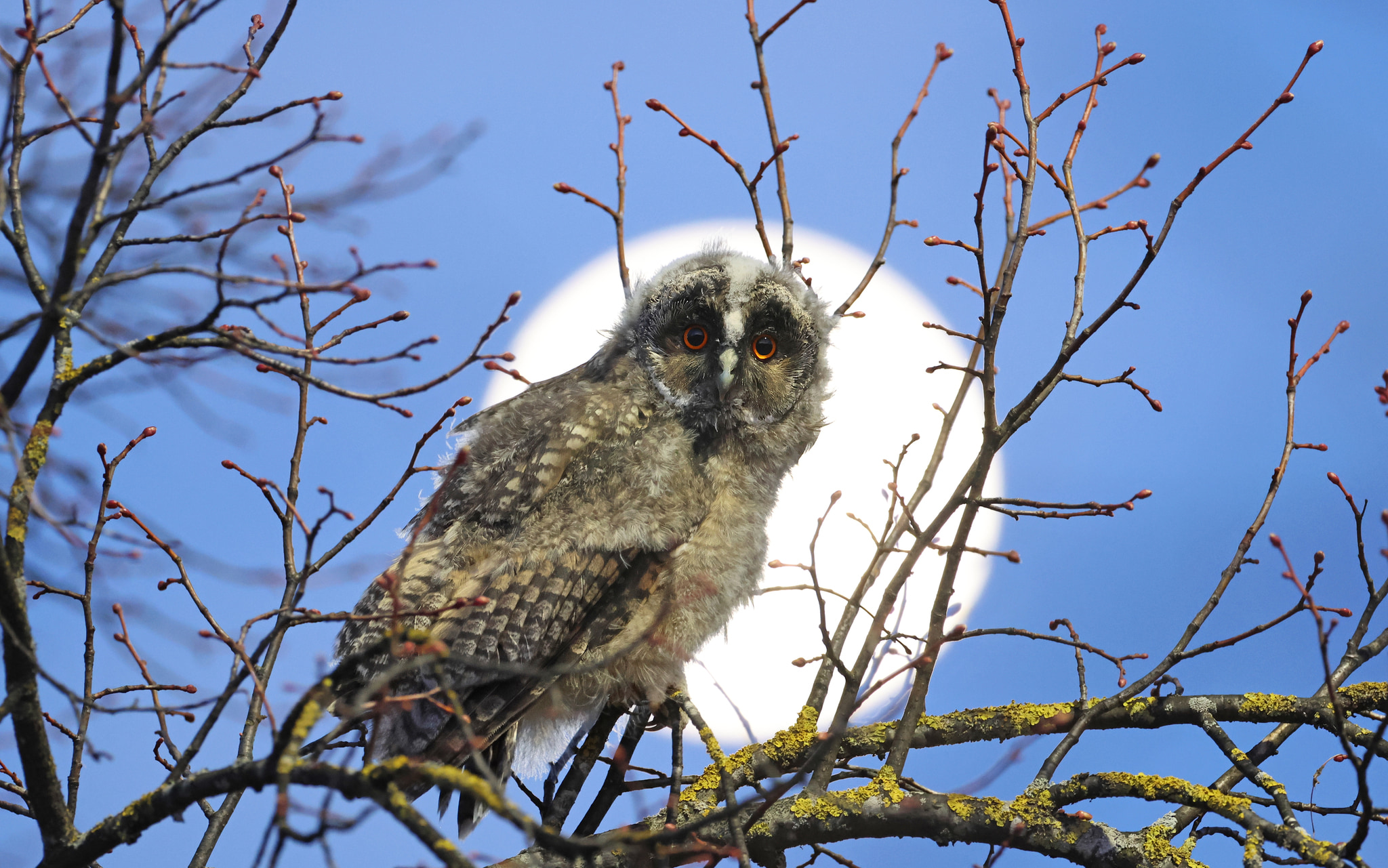
It is a night bird and becomes active at dusk. It spends the day on a branch close to the trunk, in dense foliage. If you come near, it freezes: it stretches its body, closes its eyes to narrow slits and raises its "ears". It does not defend a hunting territory and is partly migratory and nomadic. In winter 6–50 owls may roost together in one place. The male's song is a deep "hoo", repeated every few seconds, that carries 1–2 km on a calm night. It does not build a nest of its own: it uses an old nest of another bird, mostly of a crow or magpie, sometimes of a bird of prey or a heron. It usually lays 3–5 white eggs, more in years when voles are plentiful. The female incubates for 27–28 days while the male brings food to the nest. The young leave the nest at 20–27 days, still unable to fly, and clamber about the branches. At 35–37 days they fly well, and the parents feed them for up to two months.
Globally the long-eared owl's risk of extinction is rated low (LC, 2018). It is one of the most widespread and numerous owls, with 2–5.5 million birds in the world. Even so, it has declined strongly in some parts of its range. Locally it is threatened by pesticides and persecution. In Georgia's national assessment (2021) its risk is also rated low (LC), and its numbers are stable. The list of the birds of Georgia gives it as a year-round resident and breeder.
Related guides
Continue with related pages
Yes. It lives and breeds in Georgia all year round. Look for it mainly at woodland edges and in groves. It has been photographed near Akhalkalaki and near the village of Akhali Samgori.
The short-eared owl has short, almost invisible "ears" and yellow eyes, lives in open country and also hunts by day. The eagle-owl is much bigger and heavier, with its "ears" at the edges of the head. The long-eared owl has a slim body, long "ears" set near the middle of the head and orange eyes.
Above all small rodents, especially voles and mice. Sometimes it also takes birds and insects. It finds its prey mainly by sound.
It does not build a nest: it uses an old nest of another bird, mostly of a crow or magpie. It usually lays 3–5 eggs. The female incubates for 27–28 days, and the male brings food.
In winter long-eared owls often roost together by day, 6–50 owls in one grove, sometimes more. This makes them safer from predators. You may find such a group in conifer parks in towns too. Watch from a distance so as not to flush them.
No, it is harmless to people and useful. Globally its risk of extinction is low (LC, 2018). In Georgia's national assessment (2021) its risk is also low (LC), and its numbers are stable. Do not catch wild birds.
References
What this profile is based on
Species profiles are compiled from peer-reviewed literature and established biodiversity databases, and are reviewed as new taxonomic and conservation data become available.
Prepared by the Reptiles.ge editorial team from the sources listed here.


